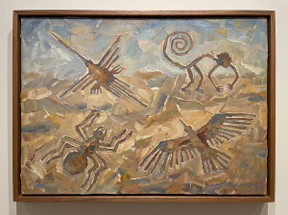
22nd May 2026
Nazca Lines
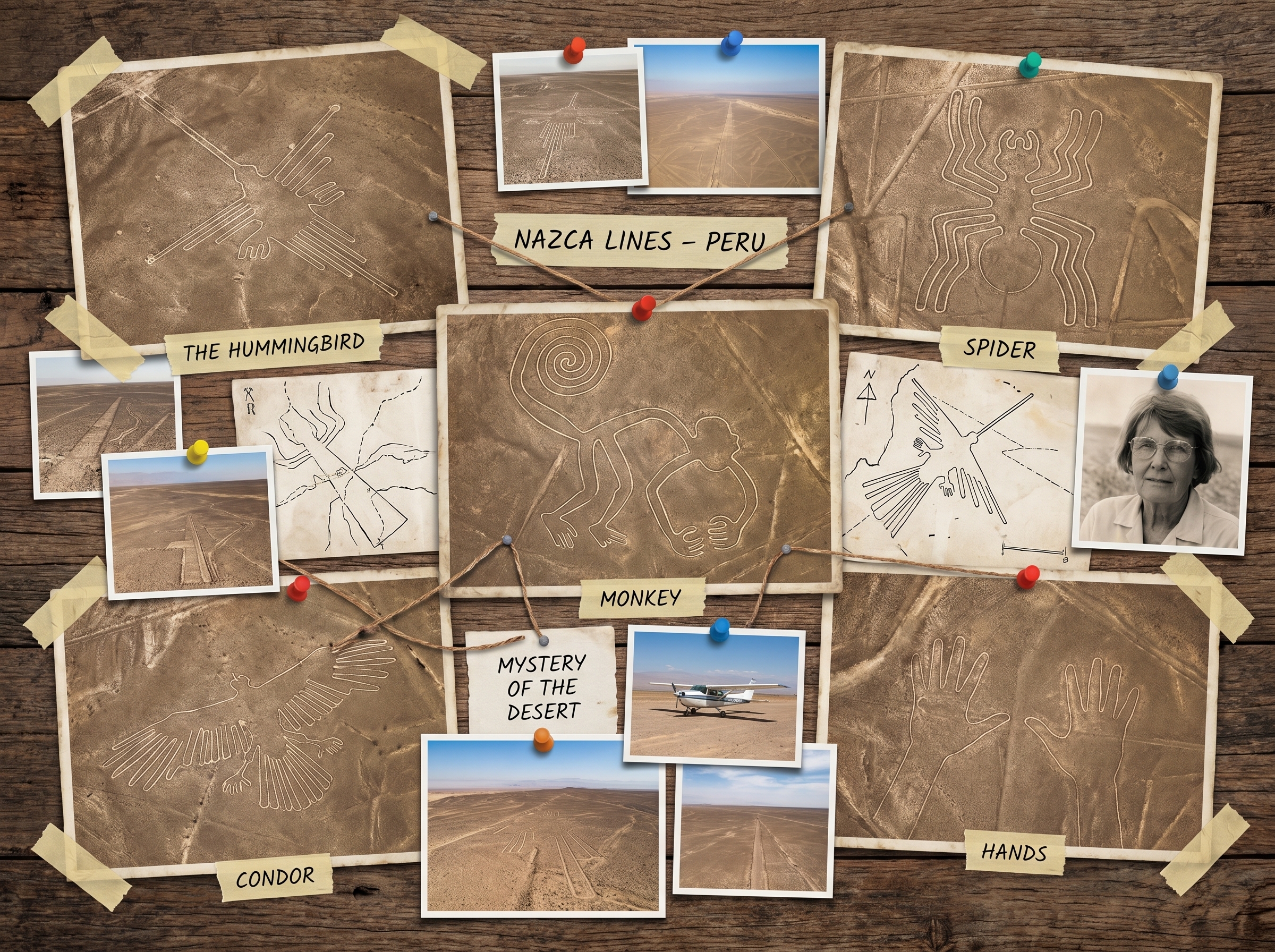
Can you imagine an art gallery so immense that the only way to appreciate its works is by flying hundreds of meters in the air? Well, there's no need to imagine it: it exists, it's located in the southern desert of Peru, and it is over 2,000 years old.
Welcome to the enigmatic world of the Nazca Lines, one of humanity's greatest archaeological mysteries.
A Giant Canvas in the Desert
The Nazca Lines are a series of ancient geoglyphs (giant drawings traced into the ground) that stretch across nearly 1,000 square kilometers in the arid Jumana pampas, in the Ica region of Peru. They were primarily created by the Nazca culture between 500 BC and 500 AD.
Although they were discovered for modern science in 1927 by Peruvian archaeologist Toribio Mejía Xesspe, it wasn't until the late 1930s, with the first commercial flights over the area, that the world realized their true and monumental magnitude. Viewed from the ground, they look like simple dirt paths or furrows; from the air, they come to life.
How Did They Make Them, and Why Haven't They Washed Away?
Contrary to popular belief, creating these lines didn't require alien technology. The method was quite ingenious yet incredibly simple: the floor of the Nazca desert is covered by a layer of dark, sun-oxidized pebbles. The ancient inhabitants simply moved these reddish stones away from the surface, exposing the lighter-colored sand underneath.
And how have they survived for over two millennia? Thanks to perfect weather. The Nazca desert is one of the driest on the planet (it receives less than a millimeter of rain per year), the temperature is stable, and there is almost no surface wind, which has prevented the sand from blowing over and erasing the strokes.
The Stars of the Desert
Among the more than 800 straight geoglyphs and 300 geometric figures, the impressive designs of animals and plants (biomorphs) stand out. Some of these measure up to 300 meters long!
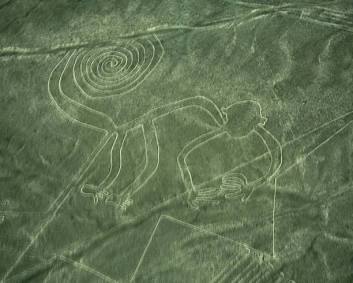
Among the most popular figures are:
-
The Monkey: At about 135 meters long, this figure features a famously spiraled tail and nine fingers.
-
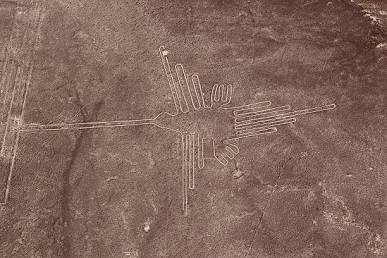
The Hummingbird: Perhaps the most iconic figure of all, measuring 96 meters long with a perfectly outlined beak and symmetrical wings.
-
The Spider: Measuring around 46 meters, it represents a type of arachnid that, interestingly enough, lives in the Amazon rainforest and not in the desert.
-
The Astronaut: A peculiar human figure with an owl-like head or a space helmet, waving from the side of a hill.
Why Were They Made? The Great Mystery
This is where things get really interesting. Why would a civilization draw figures they couldn't even see from the ground? Over the decades, several theories have been proposed:
-
The astronomical calendar: Initially proposed by Professor Paul Kosok and later expanded upon, this theory suggests that the lines point to places on the horizon where celestial bodies rise or set on key dates, such as the solstices.
-
Water and fertility rituals: This is the most widely accepted theory today, championed by archaeologist Johan Reinhard. In such an unforgiving desert, water was gold. The figures and lines are believed to have been sacred paths walked by priests during ceremonies to invoke rain and worship water deities.
-
Underground water markers: Some hydrogeologists believe the figures act as a map, directly pointing to the locations of aqueducts and underground water currents beneath the desert.
Maria Reiche: The Lady of the Lines
We can't talk about Nazca without mentioning Maria Reiche (1903-1998), a German mathematician and archaeologist who fell in love with these figures in 1940. Reiche dedicated over 50 years of her life—and all of her personal resources—to measuring, cleaning, studying, and above all, protecting the lines from being destroyed by agricultural projects and vehicle traffic.
She literally swept the lines herself with a broom and lived in the desert in a highly austere manner. Thanks to her tireless work, the Nazca Lines were preserved and officially declared a UNESCO World Heritage Site in 1994.
Consulted Sources:
-
UNESCO World Heritage Centre: Lines and Geoglyphs of Nasca and Palpa (Official heritage registry).
-
National Geographic (History): Nazca Lines: The enigma of the Peruvian desert.
-
TV Perú / Sucedió en el Perú: Documentary covering the life of Maria Reiche and the discoveries by Kosok and Mejía Xesspe.
-
Research by Johan Reinhard (1985): Studies regarding mountain worship and water rituals in the Nazca culture.
-
Yamagata University (Japan): Recent reports on the discovery of new geoglyphs using artificial intelligence.